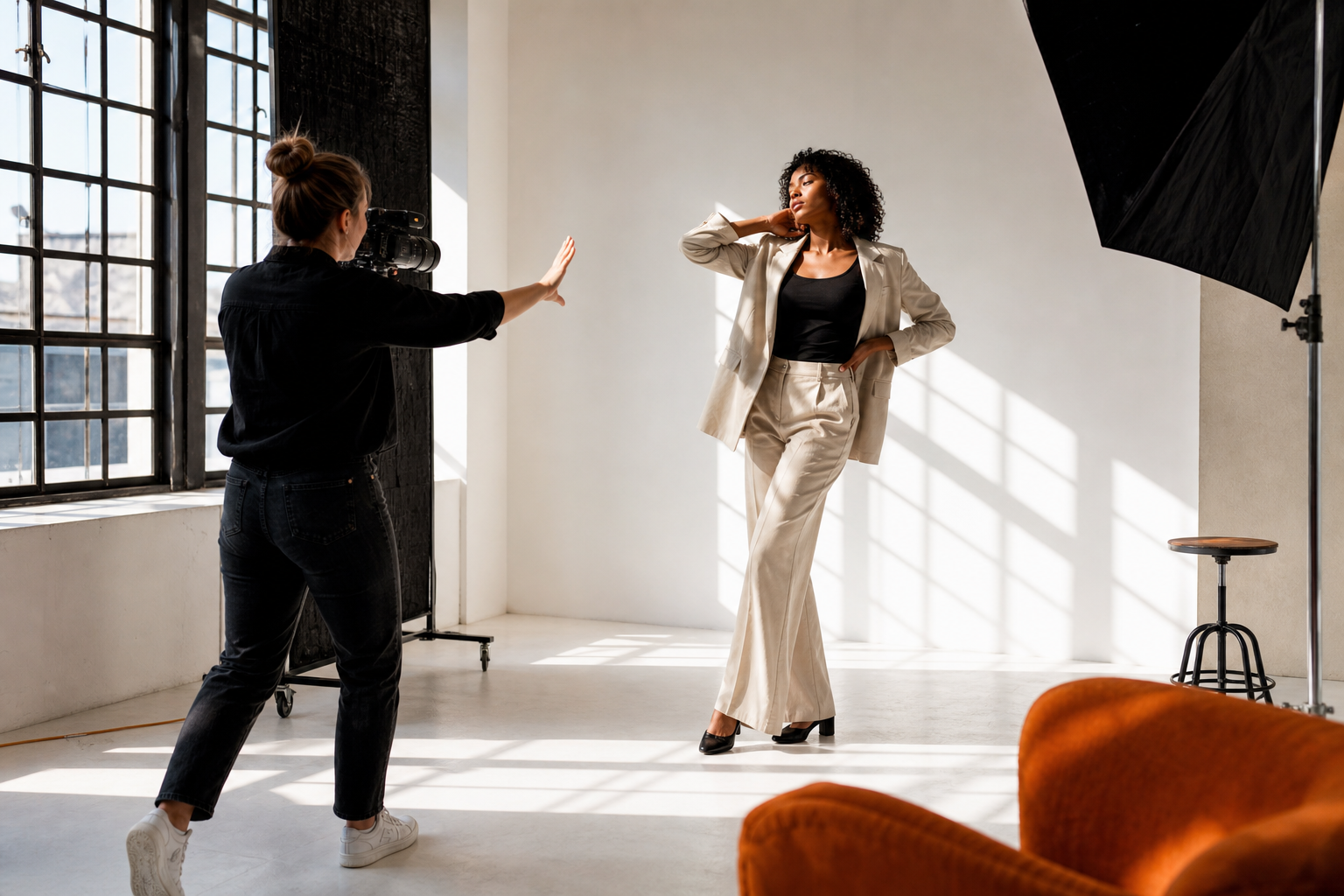
Good posing rarely looks like a sequence memorized in front of a mirror. It responds to clothing, light, framing and the emotion of the story. Before moving, decide on a simple intention such as calm, energy, distance or curiosity. That intention gives every physical choice a reason.
Start with balance. Notice where your weight sits, how your feet connect to the floor and whether your shoulders and hips support the line you want. Small shifts can change an image more effectively than dramatic gestures. Hands deserve particular attention because tension is easy to see; give them a task, a surface or a clear direction.
Movement creates transitions that a still camera can discover. Walk slowly, turn through the light, adjust a sleeve or change your focus between frames. The goal is not constant motion but a sequence of honest moments. Pause when a position feels strong so the photographer can refine composition and focus.
Reviewing contact sheets is one of the best ways to improve. Look for repeated habits, lost hands, collapsed posture and expressions that do not match the concept. Practice creates awareness, while communication with the photographer turns that awareness into a shared visual language.